"You put all participants in the same list regardless how long they operated?" The journalistic colleague was more than surprised to learn about our score lists when he questioned me about my strange hobby. To my weak reply that the basic distances of contests are mainly 24 or 48 hours he made the point: "How many can go this full distance?" I didn´t know but felt the same uneasiness that our score lists may possibly be merely a function of invested operation time than of skill and equipment. Since then I tried to get some information about real operation time of real hams. A few findings are here from four issues of Russian DX Contest and three issues of WWDX.
The best source are the statistics of the Russian DX-Contest (20052006 - link now updated to the results for Non-UA-stations) who publishes the individual operation time of each participant even band by band. I counted through the times for 745 and 936 Non-UA Single Ops in the Allband Categories (single band gives time restrictions by condx, but I´m interested in the invested Op-Time when there is no other limit than individual will and possibility). So here we go:
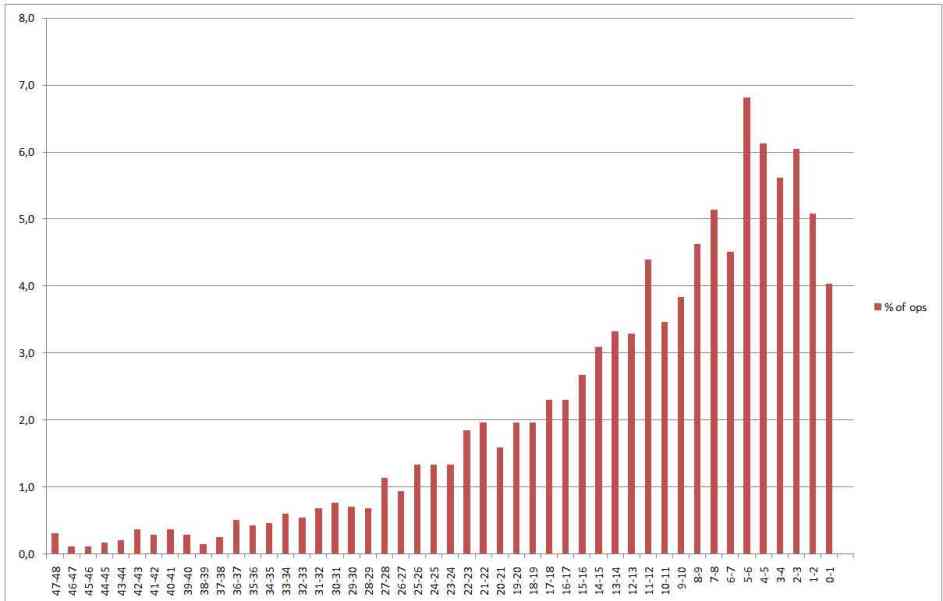
From left to right the operation periods 23-24 hours, 22-23 hours and so on with their percentage of logsending participants:
6,6 percent operated more than 23 hours in this 24 hour contest with an everybody can work everybody format.
About two thirds operated 12 hours halftime or shorter.
The average operation time was 10,8 hours (2005) and 9,8 hours (2006) with 2006 having slightly worse condx.
RDXC 2007
For 984 of 1006 Allband-entries of non-UA-stations were operation times available at the claimed scores site.
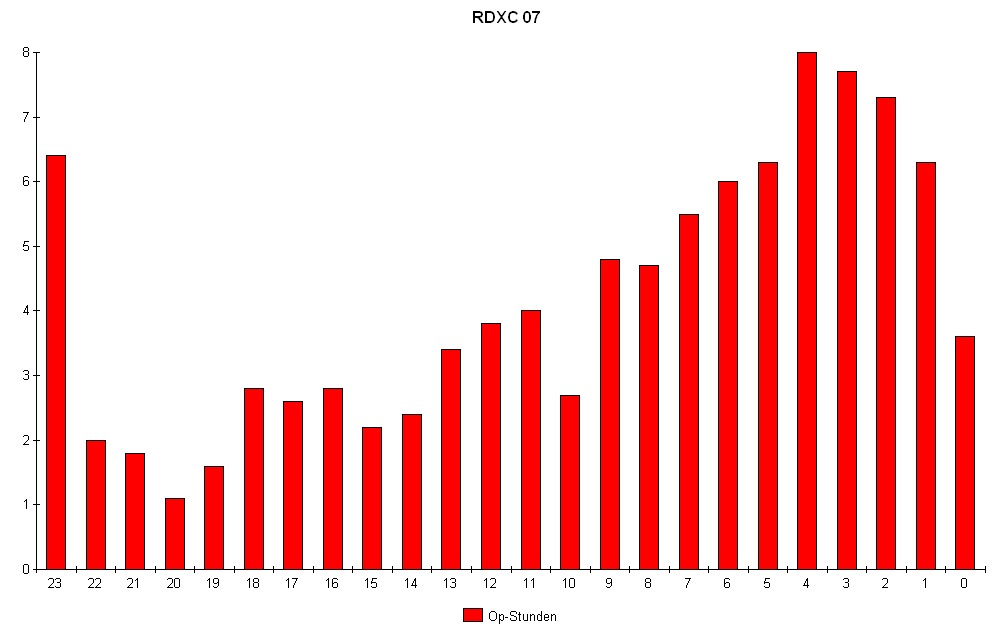
The average operation time was 9,7 hours. Again two thirds (66,9%) operated 12 hours halftime or less. 6,4 percent operated between 23 and 24 hours fulltime. The hourwise distribution can be seen in this picture:
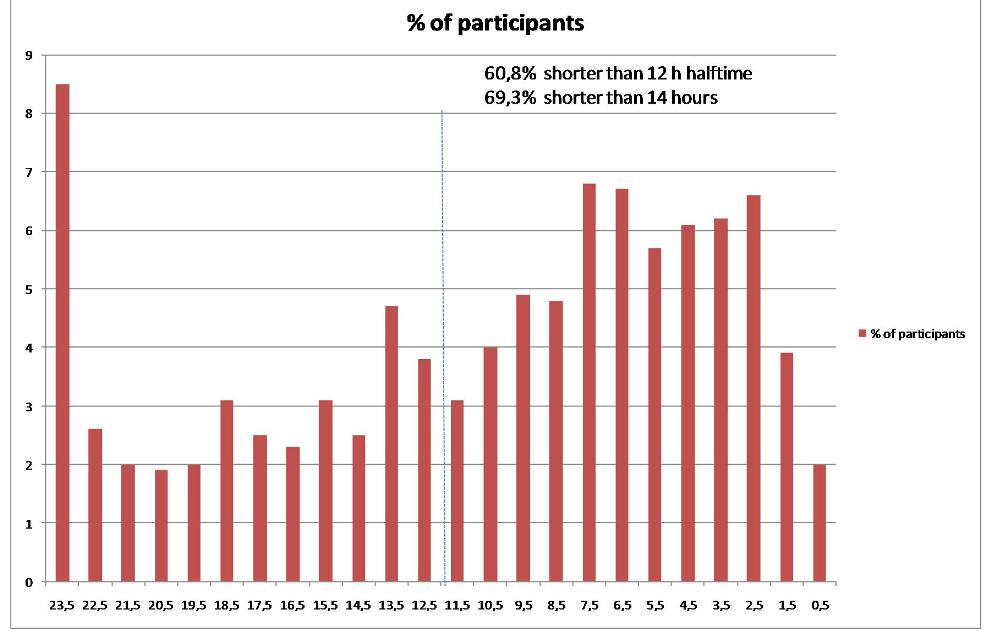
RDXC 2009 The average operation-time increased a bit to the 2005 level of 10,8 hours among the more than 1300 allband-participants. Significantly higher was especially the percentage of fulltimers with 8,5 percent - possibly due to RDXC being a WRTC-qualifier. Nevertheless the majority stayed below halftime with 60 percent operating less than 12 hours (and 69 percent below 14 hours).
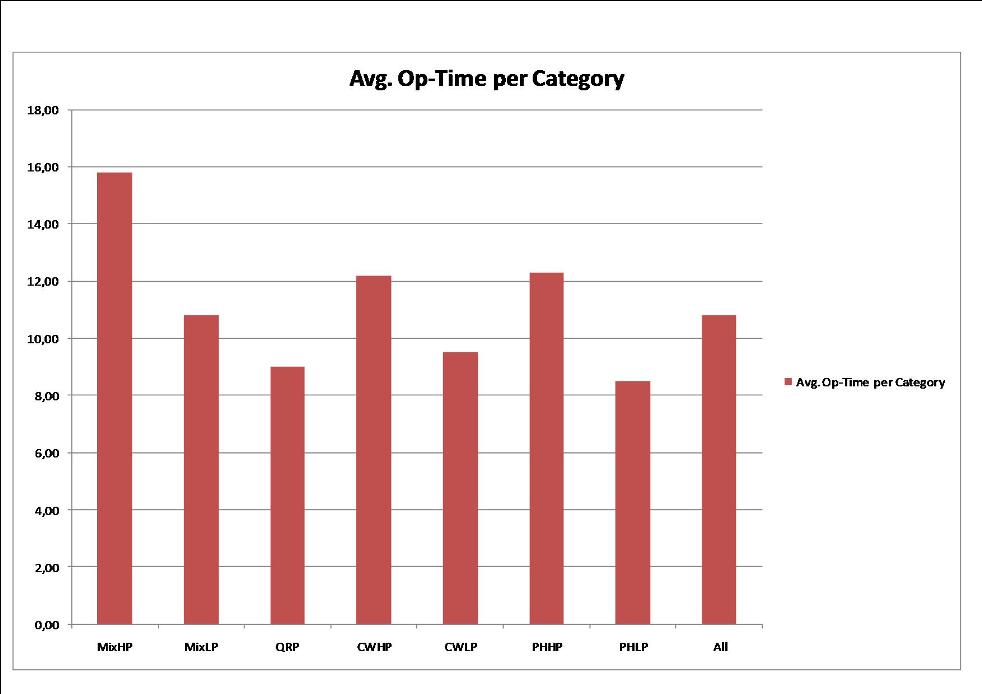
With not too brilliant condx and little or no propagation on 15 and 10m it was the usual tough job on a packed 20m band and high activity on the low bands. So it was no wonder that high power stations were best suited to stay longer in the chair. All HP-categories had higher average op-times than the LP-categories (surprisingly SSB-HP brought little longer op-times than CW-HP):
Grouped into 4-hour-segments activity over the observed four years was such:
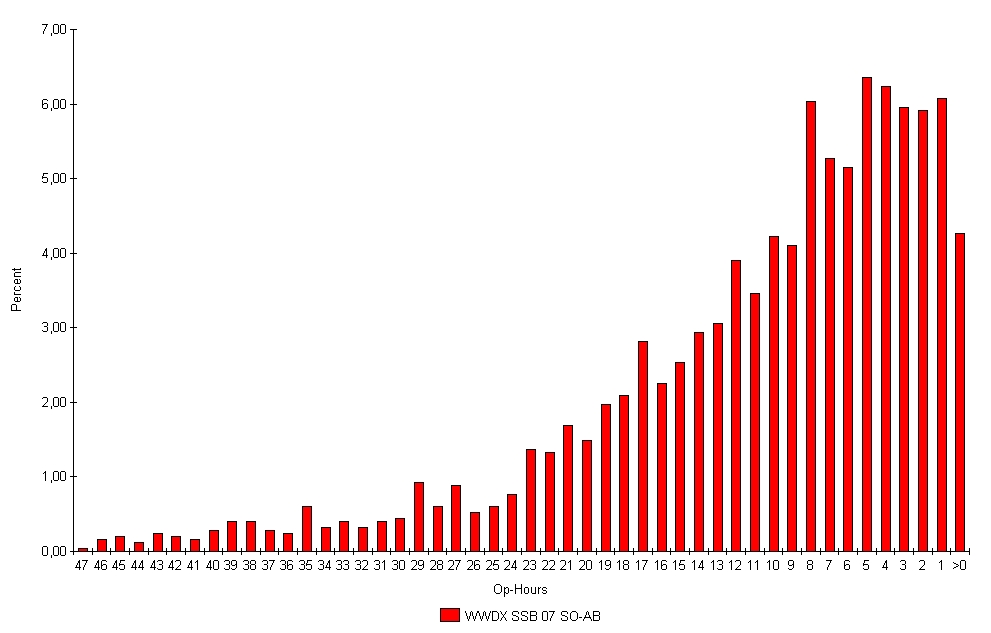
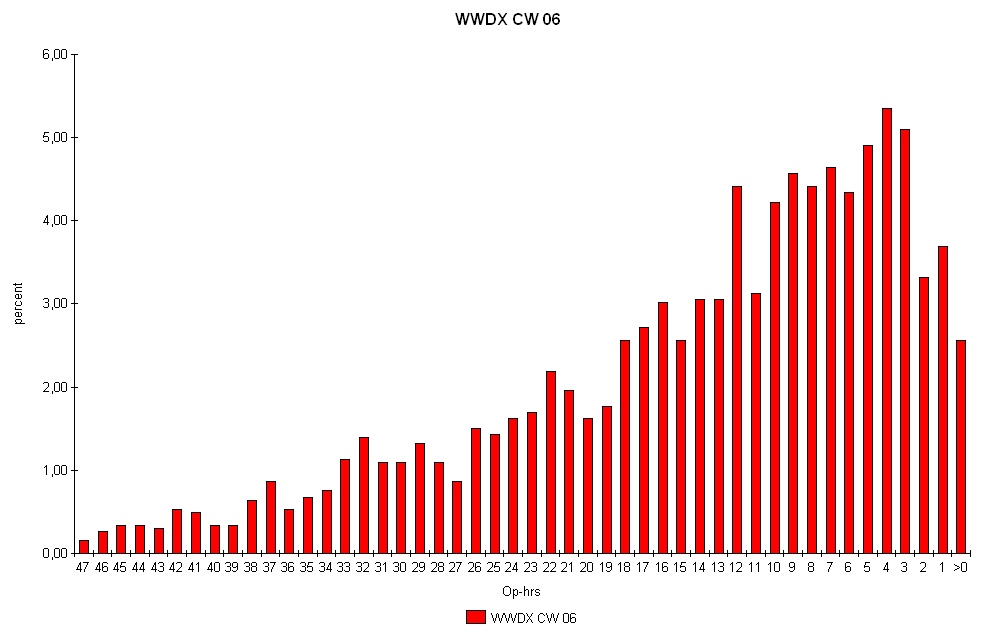
Thanks to the open logs for this contest and a software from Michael, DL6MHW (tnx!), the operation time for this big contest could be calculated. Some results from 2486 computed single-operator-allband entries:
The average operation time among those stations was 11,3 hours.
I found 35 stations operating longer than 40 hours representing 1,4% of log submitting SOAB. 130 stations (5,2%) operated longer than 30 hours
90,47 percent operated less than 24 hours halftime and 80,5% operated less than 18 hours.
And the comparison of SSB- (red) and CW-part (green)
WWDX 2009 SSB The 2009 issue of this big contest shows significant similar values to 2006: The average operation time in SOAB was 12 hour 10 minutes and again the overwhelming majority worked less than half time. 87 percent stayed below the 24-hour threshold. Every second logsending participant worked less than 12 hours. This time we set the offtime-definition to 15 minutes. With the 10-minutes definition of 2006 the average op-time would have been about 10 hours 50 minutes. Here the hourwise distribution and the same grouped in six-hours-periods.