Russian DX
Contest 2012 – Fun like a marathon run (SOAB qrp)
Friday 1900 – Arguing with software about correct
SO2R-configuration, software won out
Saturday 1250 local time – Oh oh, 10 and 15 sounded killed by
solar storm as indicated by figures on the web :-(
1300 – Start on 40m to escape initial frenzy on 20m
1330 – First hype on 20m subsides, qsos are floating
in quickly – the added 20m doublet at a fiberglass pole from the balcony works
fine
1532 – Hmmm, NH2T must be a case of S-H-problem in CW
on my end but it would be the US-multiplier. Called him and got a number
(wihout asking for repeat whohaa!), sent my number which was accepted again without
request and then "TU NH2T TEST". Whaaaat? Listened again:
"NH2T" – Yipiiiieee – that was already worth the whole contest.
1550 - 15m
deigned to give out at least three mulipliers from the Mediterrenean
1800 – 40m remains the problem bear: Lots of UA (10
pointers) to be heard, but very few workable
1928 – Ends of 20m-doublet connected with 2x12
additional wire now reaching close to ground – to be used as 80m dipole. First
test with some fear: 12 QSOs in 20 minutes – uffff, nightshift can come
2220 – Beginning despair about 40m: JH4UYB with a
supposed monster antenna could be worked, but still only about two dozen
stations from Russia – where now most go to bed...
2305 – Running two floors down in the garden to connect
the ends of the 80m-dipole with 30m wire in the fence to catch some multipliers
on 160m. Works so-so. HB9...
400km away and 20dB over S9 doesn´t even send a "?" Few more walks
down in the garden through the night
0323 – A65BP as a little relief in the 40m desert
0500 – First symptoms of increased tiredness: Confused
left and right radio and logging windows and called R9DX on 40m instead of the
hoped for 80m-band. He worked me as a dupe without comment.
0630 – 80m-extension removed and QSY to 20m. The sun
rises in the truest sense of the word: 34 QSOs with lots of multipliers in 45
minutes.
0800 – Getting fresh air buying rolls for the
awakening familiy
0948 – And it
does live! QSOs on 15m even with UA9. Hoping for more to come
1105 – Inner voice: "Ahemmm, Mr.Operator, this is
a MIXED-mode contest!" Hmmppff. Quick 15 SSB-QSO in the same number of
minutes with the suspicion that I may have lost too many qsos neglecting this
mode... Grrrrrrrrrrrr
1130 – With lunch approaching just a quick and
successful scan over a buzzing 20m-band. Doesn´t feel like qrp. Some ghosts in the ionosphere
seem to be busy compensating for some past hours.
1220 – Now! 15m open as it can be with spotlight
propagation to the oblasti south of Ural. No requests for fills and every qso
with the first call. What a final!
1257 – Last qso with 7Z1HL as new multi. Uffffffffffff.
630 QSOs
2000 – Reading 3830-reports on the net I learned that
the real good qrp-ops did >800 qsos. Room for improvement as always ;-)
QRP in a summer contest? Do it!
Report from a humble station trying to encourage for real contesting fun without kilowatt(s) and forests of Yagis
Preparation 1:
In WPX lowband-qsos have twice the value of highband-qsos. So lowbands are a must. That allows to concentrate most Op-Time during the nighttime and short intervals during daytime with the lesser propagation DX-wise. Others don´t like to be forced to operate mostly during the night but for me it gave the opportunity to have some family life in the required 12 hours offtimes which I took during the daytime (ok, no naps in this way, but there is no free lunch).
Antennas:
As main antenna I erected an often proved 40-m-doublet which works very fine on its basic band but has diminishing properties upwards. I expected 20m to be the biggest problem with the flat propagation in the two weeks before the contest. My small backyard could only host one other provisional antenna and I had to decide between something better for 20m or something for 80m. I choose an 80m-doublet @ 10m. 80m like 40m allows secure 2-pointers across Europe and also the wealth of european and especially DL-prefixes. I couldn´t find a 20m-antenna powerful enough to be sure for enough DX-3-pointers and the wealth of US-prefixes. So I had to hope for good condx on 20m.
Preparation 2:
A regular big concern in contests is how to get my 2x3-call with 13 dits in it and six final dits reliably to the other stations. I always experienced problems with the furious -... ... at the end of my call. Initially looking only for another spacing in the N1MM-software I discovered the possibility to reduce the speed of single characters in the canned messages. I programmed the final S with two wpm less than the rest of the call. Experience to follow.
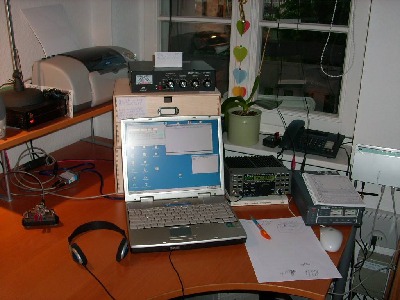
Setup on the tiny free edge on my regular working desk: The manual tuner had to go up to be still in reach for the right hand and apart from the second feedline to the automatic tuner on the right. Paper disappears in the contest.
Disappointing weather forecast speaks about heavy T-storms the whole weekend which may kind of wreck may strategy to hope for many 2-pointers and prefixes on 80-m. Many stations will have big difficulties in copying a qrp signal and also reduce their activity time on a noisy band.
THE CONTEST
I started one hour after the beginning of the contest because qrp-signals aren´t best heard during this initial hour of frenzy.
The one and only failure came with the first tuning of the 80m-antenna which showed some matching problems on the automatic tuner. So I had to add a balun and feed it in the manual tuner (which robbed the possibility to always have two tuned antennas at any time to switch faster and more easily between two bands).
Positive note: the slower S was THE success. Nearly all stations grabbed my call in the first instance - a feeling never experienced before. And that with the given amount of qrn - a significant improvement to be kept for further contests.
80 m was difficult (for the receiving stations) to say the least. But 40 went smooth with some regular DX-6-pointers. 139 QSOs at breakfast-break after 4,5 hours was nice for a qrn-haunted start. But after the following initial grabbing around 20m the daytime condx of bad sorts ruled for the rest of the day. Even not much E-skip on 10/15 and surprisingly many "CQ in the face" by UA3/UA4-stations on 20m. Two cruel hours with together only 26 QSO (is it really the first day of a big contest...) between 12.30 and 14.30 UT made it easy to switch to a family break in the garden.
This may have been the time to call it a contest, but the chance to operate a contest fulltime is so rare for me that I sticked to it - and in a more competetive sight: the condx are the same for most, like a rain shower for marathon runners.
40m in the evening was the reward with a lot of UA9-sixpointers. With piling more points than expected on 40 I allowed me the generosity to let the the german football cup final bite two 20-minute-breaks in my on-time (but it wasn´t sooo interesting compared to 40m that it would have justified the minimum one hour for a contest-offtime).
QRN on 80m again hampered nearly all qsos outside of DL during the first half of the night. Together with the low rate of DX-qsos on 20m I realized that I would not be able to raise the point-per-qso-rate compared to WPX 2006 which I had aimed for the contest (but that would be the case for nearly all competing under this condx).
In the second half of the night I paid the price for having no naps since 0300 local time saturday. Sleepiness increased to the point that it was difficult to turn the VFO-knob in the desired direction. Once I may have even overslept a serial number (at least I was not sure whether that number was sent to me the first or fifth time...). Condx didn´t help to stimulate with still high qrn on 80 which made most qsos a cumbersome test of the receiving station´s patience. But other than on a rate band like 20m they showed a lot of patience as qrn was there to be and they knew that there won´t be so big pile-ups to simply skip weak callers.
Breakfastbreak in the morning was all too welcome!
Daytime consisted of operating periods not longer than two hours which was enough with the given condx. 20m sounded a bit better - allowing at least more more UA qsos but nearly no DX besides the close-in-mediterranean DX. I had 582 qsos sunday evening with the final seven hours to go - 700 Qsos being nearly out of reach.
But then came the big reward for the quite rough going through most of the op hours: loud signals from the balkan on 15 m, really loud signals at 1900 local time. After working a lot of them easily I decided to go to 10m - hmmm, some signals audible but not really loud. First call and a quick reply. Next weak signal, call - and again reply with no hesitation and asking for repeat. Ten minutes later stations were not only easy to work but signals got louder and louder, workable stations being closer and closer up to a real S9 of DJ3WE only some 300 km away. All in all: two hours that never felt like qrp and lowwires. GREAT. Working 59 qso with 67 points could have been barely topped with looking for DX on 20m instead - so even no sorrow for giving the rate a go instead of collecting points. And it was too motivating and awakening for the final hours - better than another two hours of cumbersome S&Ping with many CQ in the face. After those two hours I was motivated to scratch the difficult qsos out of 40 and 80. Most attempts to work DX on 20m failed - resulting i.e. in 20 minutes calling 8 different US-stations with only one QSO. So back to 40 and 80.
At 2331 S53EO made it into the log for valid QSO 700. At the end the numbers of a rough but satisfying contest looked such:
Band
QSOs
Points
Mults
Pts / QSO
160m
0
0
0
0
80m
101
178
65
1,76
40m
265
623
147
2,35
20m
194
262
95
1,35
15m
83
95
30
1,15
10m
58
64
15
1,10
Total
701
1222
352
1,74
Final result = 1222 * 352 = 430.144
This 1,74 Pts per QSO were even less than 2006 with 1,84. But even the better equipped stations reported significantly less DX in the contest which turned out to be mostly domestic for most (only 10% DX here, with 28 on 40 and with 34 only little more on 20m).